Tongji University Cross-Major Transfer (Changing Majors in Freshman Spring) Explained
Last updated on July 26, 2025 pm
This article is currently an experimental machine translation and may contain errors. If anything is unclear, please refer to original Chinese version. I am continuously working to improve the translation.
This article is mainly written based on my own (Class of 2024) experience of transferring to the Software Engineering major, and is time-sensitive. Students from the Class of 2024 onward should verify the details themselves.
Make good use of Ctrl+F to search for the parts you need.
This guide may contain subjective, not fully confirmed, or unofficial content, so please use your own judgment.
I believe everyone reading this article is a freshman from the Class of 2025 or later. Perhaps you:
- Entered a college you don't really like through programs like the University Special Admission Program, and want to transfer out
- Chose a major category with a lower admission cutoff in order to aim for a better-ranked university, and want to transfer into a popular major
- etc
In any case, I believe this article can answer many of your questions!
What is cross-category stream division? Why is it called that?
Tongji University admits students in most provinces in the form of major categories:
For within-category students: (setting aside the Elite Classes, whose current policy is still unclear) after one year of study, candidates enter their respective majors according to the assessment standards set by the university, which differ for each major category, through sequential preference filling;
For non-category (cross-category) students (for example, if you are a student in the School of Civil Engineering and want to transfer into the Mechanical Engineering major of the "Intelligent Manufacturing and New Energy" category): after one year of study, candidates enter the major they wish to transfer into according to the assessment standards set by the university, which differ for each college, through a rather special process of fill in preferences first + pre-admission + final selection.
Here are explanations of some concepts above that may be unfamiliar to prospective college students:
- The relationship between major categories and colleges: Generally speaking, one major category contains multiple colleges. For example:
-
- The "Engineering Experimental Class (Information)" contains all majors of the School of Computer Science and Technology and the School of Electronic Information and Electrical Engineering;
- But the "Engineering Experimental Class (Intelligent Manufacturing and New Energy)" contains all four majors of the School of Mechanical Engineering, one major of the School of Aerospace Engineering and Applied Mechanics, one major of the School of Materials Science and Engineering, and one major of the College of Design and Innovation.
- The "Engineering Experimental Class (Information)" contains all majors of the School of Computer Science and Technology and the School of Electronic Information and Electrical Engineering;
- Therefore, there is no clear one-to-one correspondence between the two; you should look it up specifically.
- Sequential preferences: Unlike the "parallel preferences" of the Gaokao, sequential preferences can be understood as follows: during admission, the major gives priority to first-preference candidates; only if the first preference is not filled will second-preference candidates be considered, and so on. Because of this, every year many people "snag" spots in popular majors.
- Fill in preferences first + pre-admission + final selection: This will be explained later together with the cross-category stream division process.
Usually, within-category stream division and cross-category stream division (changing majors) take place at almost the same time. Students move from one major category to another, hence the name cross-category stream division.
The biggest difference between this major-change opportunity and others is that the process is open and transparent, and the assessment standards are written in black and white. Everything is done through the system, and colleges cannot block your transfer in or out, so cherish this opportunity.
What are the assessment standards for cross-category stream division?
These assessment standards change slightly every year. For the Class of 2024, the corresponding document was released in November of the first semester.

The document can be obtained by clicking this link [ https://pan.baidu.com/s/1QWHZxFqxOkVXiwuOCsvYrw?pwd=6xum Extraction code: 6xum]
It can be divided into two types: pure GPA-based and assessment-based:
Below, I will use the School of Electronic Information and Electrical Engineering and the School of Computer Science and Technology as examples to explain the cross-category assessment standards:
School of Electronic Information and Electrical Engineering (pure GPA-based)
School of Electronic Information and Electrical Engineering Class of 2024 Cross-Category Confirmation Implementation Plan
Majors included: Communication Engineering, Automation, Artificial Intelligence, Microelectronics Science and Engineering, Electrical Engineering and Automation
The admission and selection basis for cross-category major confirmation is the cross-category composite score. The cross-category composite score consists of the student's first-year average GPA, interview, special evaluation, and "Five Educations" score.
Weights: First-year GPA 70% + interview score 10% + special evaluation 10% = indicator course score 8% + innovation project (SITP) 2% + Five Educations 10%
Average GPA: No need to explain much; this knowledge is too basic. However, if you are unsure how Tongji's GPA is calculated, it's best to look it up.
Interview score: When participating in cross-category stream division, you must attend the interview of the corresponding college. Taking the one I participated in (School of Computer Science and Technology) as an example, it was 5~6 teachers sitting in a classroom, with the candidate standing at the podium. After a brief self-introduction, you answer the questions posed by the teachers. In my impression, these questions were asked wherever the teachers' thoughts happened to go. In short, the interview is not a very important component of the score.
Special evaluation: It consists of two parts:
- Indicator course score: For each college, they can single out the courses they consider relatively important, and count the GPA of only these courses a second time as part of the composite score. Here I directly quote the original document:
The indicator courses are worth a maximum of 8 points. The advanced mathematics courses (or higher-level advanced mathematics courses such as Engineering Mathematical Analysis, Mathematical Analysis, etc.) and physics courses (including physics lab courses) taken in the first year are used as indicator courses. The credit-weighted average of the GPAs of these two types of courses is taken as the average GPA, and converted into a score with a maximum of 8 points.
If advanced mathematics or physics courses have not been taken, the GPA of that course is counted as 0 in the calculation.
- Innovation project (SITP): Full name "College Student Innovation and Entrepreneurship Project". There is a first registration in December of the first semester. Once you have registered joining a project in the system, these 2 points are automatically obtained. There is no need to learn too much detail about this now; just remember to sign up when the time comes.
Five Educations score: The most formalistic one. You need to earn the corresponding "star points" on the "Excellence Star" platform by checking in at landmarks, attending lectures, participating in activities, etc., which are finally counted into the Five Educations score. I believe your counselor will explain this in detail after the semester starts, so I won't go into it here. Generally speaking, as long as you pay a bit of attention in your spare time starting from the first semester, you can get full marks when the first year is settled.
Note here that if you apply for multiple majors in the same college, these scores are shared. For example, when calculating the composite scores for Automation and Communication Engineering, the interview score is the same.
School of Computer Science and Technology (assessment-based)
School of Computer Science and Technology Class of 2024 Cross-Category Confirmation Implementation Plan
Majors included: Computer Science and Technology, Data Science and Big Data Technology, Information Security, Software Engineering
The admission and selection basis for cross-category major confirmation is the cross-category composite score. The cross-category composite score consists of the student's first-year average GPA, interview, special evaluation, and "Five Educations" score.
Weights: First-year GPA 55% + interview score 10% + special evaluation 25% = machine test score 15% + indicator course score 8% + innovation project (SITP) 2% + Five Educations 10%
The rest is largely the same; here I will focus on explaining the machine test: it is held in the same week as the interview, lasts 3 hours, and consists of 3 algorithm problems, which must be implemented in C or C++. I will upload the specific problems to my Zhihu homepage as well. The difficulty of the problems varies greatly from year to year, for reference only!! For example, the difficulty in May 2024 was far greater than that of other machine tests
A simple calculation shows that scoring 110 extra points on the machine test can offset 0.5 of GPA, which is a considerable number. Therefore, getting a high score on the machine test can give you a great advantage when changing majors.
Here, the School of Electronic Information is pure GPA-based, while the School of Computer Science is assessment-based; the School of Mechanical Engineering, the School of Physics, etc. are also pure GPA-based, while the School of Mathematical Sciences, the College of Design and Innovation, etc. are assessment-based. For details, refer to the document (the one with the cloud drive link).
What are the "fill in preferences first + pre-admission + final selection" preferences?
About two months before the major-change results come out, students must complete their major-change preference filling in the system (up to 3 preferences). Here you will be told the number of students each major will accept, but you cannot see how many people have applied.
After all the scores are released, the academic affairs office will begin calculating the composite scores for each major, and then publish the pre-admission list (roughly like this):
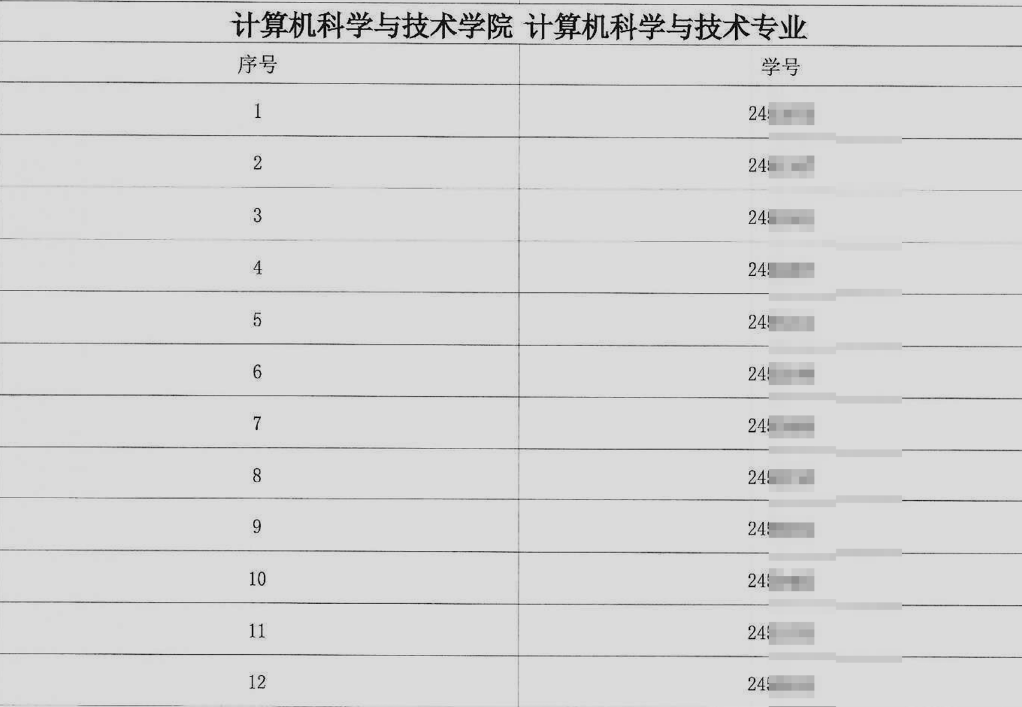
But the Computer Science and Technology major only had 6 cross-category spots for the Class of 2024, so why are there 12 people on the pre-admission list?
It can be understood this way: the college drew a line, stipulating that only these 12 people are eligible to transfer into Computer Science, but the higher up the list, the higher the composite score, and during major confirmation, they have higher priority than those below.
If you are in the top 6, you are definitely in; but if you are ranked beyond 6th, and assuming the top 6 all choose Computer Science in the end, then those ranked 7th and below who confirm Computer Science cannot be admitted, while if someone ahead gives up, those behind can be admitted smoothly.
What is worth noting very much is that the same person can appear on the pre-admission lists of multiple majors. From this, you can see that this is a winner-takes-all admission model. If you enter the pre-admission lists of multiple majors, you can finally choose one; but if you are unfortunately ranked beyond the number of admitted students, you have to try to contact the people ahead and ask whether they will actually go to the major you desire.
What is the schedule for cross-category stream division?
All the specific events take place in the second semester. Below is an example from the Class of 2024 (unimportant items omitted): (for more details, refer to this document [Link: https://pan.baidu.com/s/1tn8cUJAETNO0XsvccL2lxQ?pwd=z37q Extraction code: z37q])
| Time | Content | Notes |
|---|---|---|
| May 14, 15:00 - May 16, 12:00 | Fill in cross-category preferences | At this time you can view the number of cross-category students each major will accept in the system; up to three preferences can be filled in |
| May 26 - 30 | Participate in each college's interviews and special assessments | \ |
| July 9 | Pre-admission list published | \ |
| July 10 | Students with pre-admission eligibility confirm online | \ |
Some other common questions
Q1 What is a lateral transfer? What is a downward transfer? Are the thresholds different?
Lateral transfer is short for transferring majors at the same grade level; downward transfer is short for transferring majors with a grade drop.
A lateral transfer means being placed into a class of the same grade after transferring; a downward transfer means being placed into a class of the next grade after transferring.
A downward transfer is less stressful, because it is equivalent to starting a new major from freshman year. Moreover, since some courses have already been taken, you need to take fewer courses simultaneously compared to incoming freshmen. The cost is spending an extra year to graduate.
A lateral transfer is more stressful, because in addition to the courses to be taken in the current semester, you also need to make up the freshman-year courses of the new major.
The thresholds for the two are exactly the same. Generally, after a successful transfer, it defaults to a lateral transfer; if you want a downward transfer, you need to contact the academic affairs office, and the process is very convenient.
Q2 Course substitution and making up courses
In principle, courses of lower difficulty may not substitute for courses of higher difficulty, and courses with fewer credits may not substitute for courses with more credits.
For example, if you have already taken "Mathematical Analysis (I)" and the major you are transferring into requires "Advanced Mathematics (I)", you can use the credits of the former to substitute for the latter; conversely, if you have already taken "Advanced Mathematics (I)" but the major you are transferring into requires "Mathematical Analysis (I)", you must make up the course.
This article is continuously updated. Wishing everyone a place in the major of their dreams!